

How to increase the value of your business by 71%

Republished with permission from Built to Sell Inc.

How much did your home increase in value last year? Depending on where you live, it may have gone up by 5 – 10% or more.

How much did your stock portfolio increase over the last 12 months? By way of a benchmark, The Dow Jones Industrial Average has increased by around 13% in the last year. Did your portfolio do as well?

Now consider what portion of your wealth is tied to the stock or housing market, and compare that to the equity you have tied up in your business. If you’re like most owners, the majority of your wealth is tied up in your company. Increasing the value of your largest asset can have a much faster impact on your overall financial picture than a bump in the stock market or the value of your home.

Let us introduce you to a statistically proven way to increase the value of your company by as much as 71%. Through an analysis of 6,955 businesses, we’ve discovered that companies that achieve a Sellability Score of 80+ out of a possible 100 receive offers to buy their business that are 71% higher than what the average company receives.

How long would it take your stock portfolio or home to go up by 71%? Years – maybe even decades. Get your Sellability Score now and you will be able to track your overall score along with your performance on the eight key drivers of Sellability. Like a pilot working his instrument panel, you can quickly zero in on which of the eight drivers is dragging down your value the most and then take corrective action.

Your overall Sellability Score is derived from your performance on the eight attributes that drive the value of your company:

1. Financial Performance: your history of producing revenue and profit combined with the professionalism of your record keeping.

2. Growth Potential: your likelihood to grow your business in the future and at what rate.

3. The Switzerland Structure: how dependent your business is on any one employee, customer or supplier.

4. The Valuation Teeter Totter: whether your business is a cash suck or a cash spigot.

5. The Hierarchy of Recurring Revenue: the proportion and quality of automatic, annuity-based revenue you collect each month.

6. The Monopoly Control: how well differentiated your business is from competitors in your industry.

7. Customer Satisfaction: the likelihood that your customers will re-purchase and also refer you.

8. Hub and Spoke: how your business would perform if you were unexpectedly unable to work for a period of three months.

To find out how you’re performing on the eight key drivers of Sellability and start your journey to increasing the value of your largest asset, get your Sellability Score now:

This free online tool is the only no-risk step you can take to determine if your business is ready to get full value. Fast-track your analysis by taking advantage of this free, no-obligation free online tool.

This Sellability Score you instantly receive is a critical component to any business owner’s complete financial plan and is something that, until now, we have only made available to existing clients.

However, we recognized that there is value in knowing in advance of working with a financial planner whether or not your largest asset is ready to be exchanged for your retirement nest egg. Our view is that you are better to learn more about your businesses sellability today and find out how your business scores on the eight key attributes so that you can ensure you obtain full value.

If your business part of your retirement plan, finding out your sellability score will be the best 10 min. you could ever spend working “on” your business.

Take the Quiz here: The Business Sellability Audit
Sellability ScoreFor more free information on Creating A Business Owner’s Dream Financial Plan, you can listen to a free, eight part series we did exclusively for business owners. The show is also available to subscribe to for free via iTunes.

Why fire trucks always back in

Republished with permission from Built to Sell Inc.

Have you ever noticed that fire trucks always back into the fire hall?

Why don’t they just pull into their parking spot snout-forward like the rest of us?

Backing in at the end of a shift saves them time when they have to get to a fire. They back in to be ready; whether the call comes in 5 minutes or 5 days, they are prepared to pull out as quickly as possible.

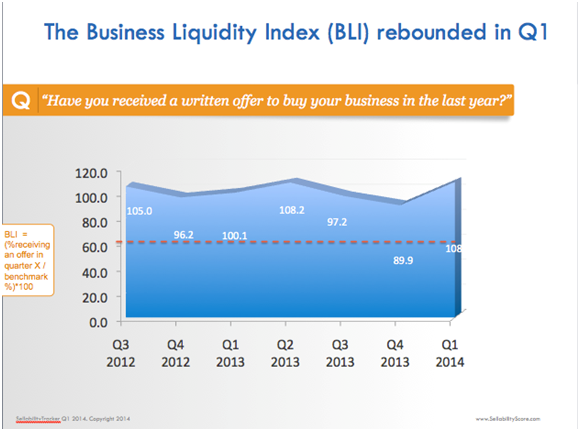
Like the firemen, you, as a business owner, need to be ready when you get the call from someone who wants to buy your business. And these days, owners are getting that call more often. According to the latest Sellability Tracker report, the proportion of business owners who received an offer to buy their company in the quarter ending March 31, 2014 was up considerably from Q4 2013. Roughly 12% of business owners using The Sellability Score last quarter had recently received an offer to buy their business.

business liquidity index

The proportion of owners getting an offer is an important statistic because it measures one half of the equation of a business sale. For a transaction to take place, there must be both a willing seller and a willing buyer.

Companies are becoming more acquisitive because they have access to more cash than they know what to do with. Interest rates are next to nothing, and after the liquidity crisis of 2008, companies have been socking away profits on their balance sheet for a rainy day.

This increase in acquisitiveness among buyers has important implications for you as a business owner. Chief among them is that you need to have a sellable asset when opportunity strikes.

Statistically speaking, the two most common reasons you are likely to sell your business are:

  1. A health scare;
  2. An unsolicited offer to buy your business.

As unsolicited offers increase, so too does the need for you to be ready if an opportunity comes your way. Unlike when the owner is in control of when he/she decides to list a property, the hallmark of an unsolicited offer is the fact that the owner doesn’t’ know when it is going happen; which means you need to operate your business as if an offer were always around the corner.

Companies that are sloppily put together with shoddy bookkeeping or too much customer concentration, or that are run by a Hub & Spoke manager, will end up being passed over for turnkey operations.

The time is now for you to get your company ready to showcase when opportunity comes knocking.

Why not find out now if your business is sellable?

This free online tool is the only no-risk step you can take to determine if your business is ready to get full value. Fast-track your analysis by taking advantage of this free, no-obligation free online tool.

This Sellability Score you instantly receive is a critical component to any business owner’s complete financial plan and is something that, until now, we have only made available to existing clients.

However, we recognized that there is value in knowing in advance of working with a financial planner whether or not your largest asset is ready to be exchanged for your retirement nest egg. Our view is that you are better to learn more about your businesses sellability today and find out how your business scores on the eight key attributes so that you can ensure you obtain full value.

If your business part of your retirement plan, finding out your sellability score will be the best 10 min. you could ever spend working “on” your business.

Take the Quiz here: The Business Sellability Audit

Sellability ScoreFor more free information on Creating A Business Owner’s Dream Financial Plan, you can listen to a free, eight part series we did exclusively for business owners. The show is also available to subscribe to for free via iTunes.

8 ways to know if you have a job or own a business

Republished with permission from Built to Sell Inc.

The ultimate test of your business can be found in a simple question: would someone want to buy your company?

Whether you want to sell next year or a decade from now, you must be building an asset

someone would buy – otherwise, you have a job, not a business.

Here are eight ways to ensure you are building a company, not just doing a job:

  1. A job requires that you show up at work to make money, whereas a company generates revenue whether you are there or not.
  2. If your company is so reliant on a single customer that they can dictate how you deliver your product or service, your company is more like a job than a valuable business.
  3. A job is a place where your personal reputation impacts your results, whereas a company is a place where the brand is more important than the personality of the founder(s).
  4. A job requires you to use your personal experience and expertise to get a result, whereas a company is a place where a process – not a person – consistently produces a desirable result.
  5. In a job, you get fired for taking too much vacation, whereas if you own a company, the more vacation you can take without impacting your company’s performance, the more valuable your business will be.
  6. In a job, the harder you work, the more money you earn. In a company, the smarter you work, the more money you earn.
  7. In a job, you solve the problems. If you own a company, your employees solve the problems.
  8. If the majority of your customers know your mobile phone number, it’s likely you have a job, not a company.

If you’re not sure whether you have a job or own a business, it’s time to get your Sellability Score. Whether you want to sell now or in a decade, the Sellability Score assessment allows you to see your business as a buyer would see it, and to identify how you perform on each of the eight key drivers of sellability. The questionnaire takes about 13 minutes to complete, and after you’re finished you’ll get a customized 27-page report outlining how you performed and where you could improve the value and sellability of your company. Get your score now (link to the Sellability Score questionnaire on your site).

Why not find out now if your business is sellable?

This free online tool is the only no-risk step you can take to determine if your business is ready to get full value. Fast-track your analysis by taking advantage of this free, no-obligation free online tool.

This Sellability Score you instantly receive is a critical component to any business owner’s complete financial plan and is something that, until now, we have only made available to existing clients.

However, we recognized that there is value in knowing in advance of working with a financial planner whether or not your largest asset is ready to be exchanged for your retirement nest egg. Our view is that you are better to learn more about your businesses sellability today and find out how your business scores on the eight key attributes so that you can ensure you obtain full value.

If your business part of your retirement plan, finding out your sellability score will be the best 10 min. you could ever spend working “on” your business.

Take the Quiz here: The Business Sellability Audit

Sellability ScoreFor more free information on Creating A Business Owner’s Dream Financial Plan, you can listen to a free, eight part series we did exclusively for business owners. The show is also available to subscribe to for free via iTunes.

5 “strategic” ways to sell your company

Republished with permission from Built to Sell Inc.

This month’s article looks at the recent announcement that Facebook has acquired messaging service WhatsApp and uses it as a platform to discuss the topic of strategic acquisition. The article also shares five ways your clients can position their company to be bought by a strategic.

Did you see the news that Facebook has recently acquired Internet messaging service WhatsApp for $19 billion? It represents the largest-ever acquisition of an Internet company in history.

WhatsApp is a pearl for sure. The messaging service allows users to avoid text-messaging charges by moving texts across the Internet instead of the mobile phone carrier networks. This can save people who travel, or who live in emerging markets, hundreds of dollars a year, which is why WhatsApp is adding one million new users per day.

At the time of the acquisition in February 2014, WhatsApp had acquired some 450 million users. Their business model is to charge a subscription of $1 per year after their first full year of service. Even if all 450 million WhatsApp users were already paying, that is still less than half a billion in revenue. Why would Facebook acquire WhatsApp for a number that is somewhere north of 40 times revenue?

Nobody know for sure what is in Mark Zuckerberg’s head, but we can only assume that at least part of the opportunity Facebook sees is the opportunity to sell more Facebook ads because of the information they glean from WhatsApp users. Global advertising giant Publicis estimates 2013 online advertising spending in the US alone to be around $500 billion. Presumably Facebook believes they can get a larger chunk of the global online ad buy because they know more about its users by owning WhatsApp.

And therein lies the definition of a strategic acquisition. Most acquisitions run a predictable pattern of industry norms, but a strategic can pay a significant premium for your business because they are looking at your business for what it is worth in their hands. Rather than forecasting out your future profits and estimating what that cash is worth in today’s dollars, a strategic is calculating the economic benefit of grafting your business onto theirs.

There can be many strategic reasons why a big company might want to buy yours. Here are a few to consider:

1. To control their supply chain

In 2011, Starbucks announced it had acquired Evolution Fresh, one of their providers of juice drinks, for $30 million. Now Starbucks is no longer beholden to one of its suppliers.

2. To give their sales people something else in their briefcase

Also in 2011, AOL announced the acquisition of The Huffington Post for $315 million, even though HuffPo had just turned its first modest profit on paper. AOL wanted to give its advertising sales people more inventory to sell and HuffPo had 26 million unique visitors a month.

3. To make their cash cow product look sexier

Microsoft bought Skype for $8.5 billion dollars even though Skype was losing money. The good folks in Redmond must have assumed they could sell more Windows, Office and Xbox by integrating Skype into everything they already sell.

4. To enter a new geographic market

Herman Miller paid $50 million to acquire China’s POSH Office Systems in order to get a beachhead into the world’s fastest growing market for office furniture.

5. To get a hold of your employees

Facebook reportedly acquired Internet start-up Hot Potato for $10 million, largely to get hold of the talented developers working at the company.

Most acquisitions are done for rational reasons where an acquirer agrees to pay today for the rights to your future stream of cash. You may, however, be able to get a significant premium for your company if you can figure out how much it is worth in someone else’s hands.

Why not find out now if your business is sellable?

This free online tool is the only no-risk step you can take to determine if your business is ready to get full value. Fast-track your analysis by taking advantage of this free, no-obligation free online tool.

This Sellability Score you instantly receive is a critical component to any business owner’s complete financial plan and is something that, until now, we have only made available to existing clients.

However, we recognized that there is value in knowing in advance of working with a financial planner whether or not your largest asset is ready to be exchanged for your retirement nest egg. Our view is that you are better to learn more about your businesses sellability today and find out how your business scores on the eight key attributes so that you can ensure you obtain full value.

If your business part of your retirement plan, finding out your sellability score will be the best 10 min. you could ever spend working “on” your business.

Take the Quiz here: The Business Sellability Audit

Sellability ScoreFor more free information on Creating A Business Owner’s Dream Financial Plan, you can listen to a free, eight part series we did exclusively for business owners. The show is also available to subscribe to for free via iTunes.

6 little things that make a big difference to the value of your company

Republished with permission from Built to Sell Inc.

With the Sochi Olympic Games taking place this month, it is interesting to reflect back on some of the big events of the 2010 Olympic Games in Vancouver.

In the Men’s Downhill race at Whistler, for example, the winning time of 1:54:31 was posted by Didier Défago of Switzerland. The time among medalists was the closest in Olympic history, and while Mario Scheiber of Austria posted a time of 1:54:52 – just two tenths of a second slower than Défago – he finished out of the medals in fourth place.

In ski racing, one fifth of a second can be lost in the tiniest of miscalculations.  And when it comes to selling your business, markets can be equally cruel. Get everything right, and you can successfully sell your business for a premium. Misjudge a couple of minor details and a buyer can walk, leaving you with nothing.

Here is a list of six little details to get right before you put your business on the market:

  1. Find your lease. If you rent space, you may be required to notify your landlord if you intend to sell your company. Read through the fine print and ensure you’re not scrambling at the last minute to seek permission from your landlord to sell.
  2. Professionalize your books. Consider having audited financial statements prepared to give a buyer confidence in your bookkeeping.
  3. Stop using your company as an ATM.  Many business owners run trips and other perks through their business, but if you’re planning to sell, these treats will artificially depress your earnings, which will reduce the value of your company in the eyes of a buyer by much more than the value of the perks.
  4. Protect your gross margin. Oftentimes, when leading up to being listed for sale, companies grow by chasing low-margin business. You tell yourself you need top-line growth, but when an acquirer sees your growth has come at the expense of your gross margin, she will question your pricing authority and assume your journey to the bottom of the commoditization heap has begun.
  5. If you’re lucky enough to have formal contracts with your customers, make sure your customer contracts include a “survivor clause” stipulating that the obligations of the contract “survive” the change of ownership of your company. That way, your customers can’t use the sale of your company to wiggle out of their commitments to your business. Have a lawyer paper the language to ensure it has teeth in your jurisdiction.
  6. Get your Sellability Score. Take 13 minutes to answer the Sellability questionnaire now. You’ll see how you performed on the eight key drivers of sellability and you can identify any gaps you need to fill before taking your business to market.

Like competing in the Olympics, selling a business can be an all-or-nothing affair. Get it right and you will walk away a winner. Fumble your preparation, and you could end up out of the medals.

Why not find out now if your business is sellable?

This free online tool is the only no-risk step you can take to determine if your business is ready to get full value. Fast-track your analysis by taking advantage of this free, no-obligation free online tool.

This Sellability Score you instantly receive is a critical component to any business owner’s complete financial plan and is something that, until now, we have only made available to existing clients.

However, we recognized that there is value in knowing in advance of working with a financial planner whether or not your largest asset is ready to be exchanged for your retirement nest egg. Our view is that you are better to learn more about your businesses sellability today and find out how your business scores on the eight key attributes so that you can ensure you obtain full value.

If your business part of your retirement plan, finding out your sellability score will be the best 10 min. you could ever spend working “on” your business.

Take the Quiz here: The Business Sellability Audit

Sellability ScoreFor more free information on Creating A Business Owner’s Dream Financial Plan, you can listen to a free, eight part series we did exclusively for business owners. The show is also available to subscribe to for free via iTunes.

Will your business be more valuable this time next year?

Republished with permission from Built to Sell Inc.

For many, January is a time of rebirth and resolutions. It’s a month to reflect on last year’s achievements and to set goals for the year ahead.

Some people will set personal goals like losing weight or quitting a nasty habit, and most company owners will set business goals that focus on hitting certain revenue or profit milestones. But if your goal is to own a more valuable business in 2014, you may want to make one of the following New Year’s resolutions:

  • Take a two-week vacation without checking in with the office. When you return, you’ll see how well your company performed and where you need to make a key hire or create a new system.
  • Write down at least one process per month. You know you need to document your systems, but you may be overwhelmed by the task of taking what’s inside your head and putting it down in writing for others to follow. Resolve to document one system a month and by the end of the year you’ll own a more sellable company.
  • Offload at least one customer relationship. If you’re like most business owners, you’re still your company’s best salesperson, but this can be a liability in the eyes of an acquirer, which is why you should wean your customers off relying on you as their point person. By the time you sell, none of your key customers should think of you as their relationship manager.
  • Cultivate a new relationship with a new supplier. Having a “go to” group of suppliers is great, but an over-reliance on one or two suppliers can create a liability for your business. By spreading some of your business to other suppliers, you keep your best suppliers hungry and you can make a case to an acquirer that you have other sources of supply for your critical inputs.
  • Create a recurring revenue stream. Valuable companies can look into the future and see where their revenue is going to come from. Recurring revenue models can vary from charging customers a small amount for a special level of service to offering a warranty or service contract.
  • Find your lease (and any other key contracts). When it comes time to sell your company, a buyer will want to see your lease and understand your obligations to your landlord. Having your lease handy can save time and avoid any nasty surprises at the eleventh hour in the process of selling your company.
  • Check your contracts and make sure they would survive the change of ownership of your company. If not, talk to your lawyer about adding a line to your agreements that states the obligations of the contract “surviving” in the event of a change of ownership of your company.
  • Start tracking your Net Promoter Score (NPS). The NPS methodology is the best predictor that your customers will re-purchase from you and/or refer you, which are two key indicators of a healthy and successful company. It’s also why many strategic acquirers and private equity companies use NPS as a way to measure the health of their acquisition targets during due diligence.
  • Get your Sellability Score. All goals start with a benchmark of where you’re at today, and by understanding your company’s Sellability Score, you can pinpoint how you’re doing now and which areas of your business are dragging down your company’s value.

A lot of company owners will set New Year’s resolutions around their revenue or profits for the year ahead, but those goals are blunt instruments. Instead of just building a bigger company, also consider making this the year you build a more valuable one.

Why not find out now if your business is sellable?

This free online tool is the only no-risk step you can take to determine if your business is ready to get full value. Fast-track your analysis by taking advantage of this free, no-obligation free online tool.

This Sellability Score you instantly receive is a critical component to any business owner’s complete financial plan and is something that, until now, we have only made available to existing clients.

However, we recognized that there is value in knowing in advance of working with a financial planner whether or not your largest asset is ready to be exchanged for your retirement nest egg. Our view is that you are better to learn more about your businesses sellability today and find out how your business scores on the eight key attributes so that you can ensure you obtain full value.

If your business part of your retirement plan, finding out your sellability score will be the best 10 min. you could ever spend working “on” your business.

Take the Quiz here: The Business Sellability Audit

Sellability ScoreFor more free information on Creating A Business Owner’s Dream Financial Plan, you can listen to a free, eight part series we did exclusively for business owners. The show is also available to subscribe to for free via iTunes.

Do you know your CUF:CAC ratio?

Republished with permission from Built to Sell Inc.

The most powerful metrics in any business are ratios that express your performance on metric A as it relates to metric B. For example, knowing what your revenue was last year is interesting; but knowing what your revenue per employee was will give you a sense of how efficient your business is at leveraging your investment in people.

If you’re a retailer, knowing what your sales were last year is far less useful than knowing what your sales per square foot were, as this measures your effectiveness at leveraging your investment in retail space.

One of the most important ratios to keep an eye on is your ratio of CUF:CAC. CUF stands for Cash Up Front, and it is the amount of money you get from a customer when they decide to buy. CAC stands for Customer Acquisition Cost, and it is the amount of money you need to invest in sales and marketing to win a new customer.

Improving your CUF:CAC ratio can ensure that you have the cash to grow your business without having to rely heavily on outside sources of capital.

HubSpot

To understand the CUF:CAC ratio, let’s first look at HubSpot.com. HubSpot is a software business that provides a platform for businesses to manage all of their marketing. HubSpot allows businesses to build a website, set up a blog, manage their social media accounts, create email marketing campaigns, and analyze it all through a single dashboard. It’s an all-in-one marketing platform for businesses, and HubSpot’s typical customer is a small to mid-sized company that needs to present a professional online image but doesn’t have the necessary internal resources or the budget to hire a team of designers.

According to a recent article in Forbes, HubSpot invested an average of $6,793 to win a new customer in Q2 2012. Their average customer paid $577 per month for access to the software, so if HubSpot had charged its customer just the monthly subscription fee, their CUF:CAC ratio would have been an abysmal .084:1.

But obviously HubSpot is in the subscription business, so they get $577 per month, and their average customer stays with HubSpot for more than three years, so they clearly recover the cost of acquisition over the lifetime of the customer. However, if they hadn’t had a strategy to improve their initial CUF:CAC, they would have required a boatload of money from outside investors.

To improve their CUF:CAC, HubSpot sells an “Inbound Marketing Success Training” package and charges new customers $2,000 to recover some of the costs of getting them set up. By charging $2000 upfront for the training package, their CUF:CAC ratio goes up to a much more respectable .37:1.

Forrester Research

To understand a company with an excellent CUF:CAC ratio, take a look at Cambridge, Massachusetts-based Forrester Research. Forrester’s primary business is selling syndicated market research on a subscription basis to billion-dollar companies. Founded in 1983, today Forrester generates roughly $300 million dollars in revenue from 2,451 customers, including 38 percent of the Fortune 1000.

Their core product is called “RoleView,” and for around $30,000 per year, Chief Information Officers (CIOs) and Chief Marketing Officers (CMOs) can get research insights delivered to them based on their functional role within their company. Each RoleView subscription typically includes access to research, membership in a Forrester leadership board where peers discuss issues they have in common, phone and email access to the analysts who perform the research, unlimited participation in Forrester Webinars, and the right to attend one live event.

Unlike HubSpot that primarily charges by the month, Forrester RoleView subscriptions are mostly charged annually, upfront. Subscribers get an entire year’s worth of their customer’s money in advance, giving them a positive CUF:CAC ratio. George F. Colony, CEO and Chairman of Forrester, revealed the benefit of charging upfront for subscriptions in his letter to shareholders in early 2013. He concluded: “Forrester’s business model yields healthy levels of free cash flow. We typically carry between 50 and 100 million dollars in cash.”

Your CUF:CAC ratio is all about improving the cash flow in your business, which is one of the eight key drivers of Sellability.

Why not find out now if your business is sellable?

This free online tool is the only no-risk step you can take to determine if your business is ready to get full value. Fast-track your analysis by taking advantage of this free, no-obligation free online tool.

This Sellability Score you instantly receive is a critical component to any business owner’s complete financial plan and is something that, until now, we have only made available to existing clients.

However, we recognized that there is value in knowing in advance of working with a financial planner whether or not your largest asset is ready to be exchanged for your retirement nest egg. Our view is that you are better to learn more about your businesses sellability today and find out how your business scores on the eight key attributes so that you can ensure you obtain full value.

If your business part of your retirement plan, finding out your sellability score will be the best 10 min. you could ever spend working “on” your business.

Take the Quiz here: The Business Sellability Audit

Sellability ScoreFor more free information on Creating A Business Owner’s Dream Financial Plan, you can listen to a free, eight part series we did exclusively for business owners. The show is also available to subscribe to for free via iTunes.

Growth vs. Value: not all revenue is created equally

Republished with permission from Built to Sell Inc.

When you look ahead to next year, will your growth come from selling more to your existing customers or finding new customers for your existing products and services?

The answer may have a profound impact on the value of your business.

Take a look at the research coming from a recent analysis of owners who completed their Sellability Score questionnaire. We looked at 5,364 businesses and found that the average company that had received an overture from an acquirer was offered 3.5 times their pre-tax profit.  When we isolated just the businesses that had a historical growth rate of 20 percent or greater, the multiple offered improved to 4.3 times pre-tax profit, or about 20 percent more than their slower growth counterparts.

However, the real bump in multiple came when we isolated just those companies that claim to have a unique product or service for which they have a virtual monopoly. The niche companies enjoyed average offers of 5.4 times pre-tax profit, or roughly 50 percent more than the average companies, and fully 20 percent more than the fastest growth companies.

Nurture your niche

Chasing “bad” revenue by offering a wide array of products and services is common among growth companies. The easiest way to grow is to sell more things to your existing customers, so you just keep adding adjacent product and service lines. But when a strategic acquirer buys your business, they are buying something they cannot easily replicate on their own.

A large company will place less value on the revenue derived from products and services that you have in common. They will argue that their economies of scale put them in a better position to sell the things that you both offer today.

Likewise, they will pay the largest premium to get access to a new product or service they can sell to their customers. Big, mature companies have customers and systems, but they sometimes lack innovation; and many choose a strategy of acquisition as a way to buy their innovation.

Focusing on your niche is one of many areas where the long-term value of your business is at odds with short-term profit. For example, if you wanted to maximize your short-term profit, you might avoid investing in new technology or hiring a head of sales, arguing that both investments would hinder short-term profit. The truly valuable company finds a way to deliver profit in the short term while simultaneously focusing their strategy on what drives up the value of the business.

Why not find out now if your business is sellable?

This free online tool is the only no-risk step you can take to determine if your business is ready to get full value. Fast-track your analysis by taking advantage of this free, no-obligation free online tool.

This Sellability Score you instantly receive is a critical component to any business owner’s complete financial plan and is something that, until now, we have only made available to existing clients.

However, we recognized that there is value in knowing in advance of working with a financial planner whether or not your largest asset is ready to be exchanged for your retirement nest egg. Our view is that you are better to learn more about your businesses sellability today and find out how your business scores on the eight key attributes so that you can ensure you obtain full value.

If your business part of your retirement plan, finding out your sellability score will be the best 10 min. you could ever spend working “on” your business.

Take the Quiz here: The Business Sellability Audit

Sellability ScoreFor more free information on Creating A Business Owner’s Dream Financial Plan, you can listen to a free, eight part series we did exclusively for business owners. The show is also available to subscribe to for free via iTunes.